1 January 2013
11 May 2012
when you miss someone, there produces a slight gap in time, where one should have a heartbeat or a pause between beats, and when you miss someone there are non-moments when neither exist!
no one knows where these beats and non-beats go. some speculate that they seek the person their conductor misses, in order to give them an extra piece of life to help them
of course, if two people miss each other exactly the same, beats and non-beats, misser and missie sort of cancel each other out and then the whole phenomena feels less anxious and more comfortable - when a sense of balance in the heart area exists!
the end

Labels: poetry
29 April 2012


 |  |
the first part is musarc singing in a large gallery space, standing in a circle, facing inward with audience scattered around us, their backs the the wall. our conductor, cathy heller jones, instructs us to synchronise record on the dictaphones.

the second part of the performance begins when we stop singing and stop recording, rewind, press play, set the dictaphone at our feet and disperse into the audience. we assumed pseudo-formal poses while we, along with the audience, listened back to the tapes. the out-of-sync tapes satanic or at least darkly-heavenly tone. the performance ends when the last tape reaches the end.

corpus sonus is a revisited version of william byrd's ave verum corpus. the original concept of this revisit was introduced by the talented sam belinfonte with contributions from Original idea by Sam Belinfante with contributions from Toby O’Connor, Cathy Heller Jones, Maria Smith, John Bingham-Hall, Esther Waterfield, Joseph Kohlmaier, Hannes Voss, Mela Boev and the ensemble. musarc performed this new commission at margate's turner contemporary gallery, on occasion of the gallery's first birthday.
www.musarc.org
Labels: byrd, experiment, musarc, music, performance
29 March 2012
working as a freelance designer with jason bruges studio, i was one of two people designing the names and lighting for bbc radio 4. more info to follow!
Labels: bbc, film, jbs, narrative
19 February 2012
above : "The high speed flash head was tested for 700 shots, one every 5 seconds, to detect irregularities in Flash power and light characteristics" from vimeo page description of the fascinating digital mediators factum arte
"the idea that i might already have gone blind struck me with sudden terror.... i might only be using people's words and voices to reconstruct the lost world of reality, just as our mind, at the moment we fall asleep, forms images resembling those of real life from the phosphenes that dance before our closing eyes. i stood on the threshold of reality and imagination, and i began to doubt which was which"
Figyes Karinthy [2008] Journey Round My skull. New york: nyrb classicsas quoted in oliver sacks [2010] The Mind's Eye, Picador, London, p180
"How often, asleep at night, am I convinced of just such familiar events — that I am here in my dressing gown, sitting by the fire —when in fact I am lying undressed in bed! Yet at the moment my eyes are certainly wide awake when I look at this piece of paper; I shake my head and it is not asleep; as I stretch out and feel my hand I do so deliberately, and I know what I am doing. All this would not happen with such distinctness to someone asleep. Indeed! As if I did not remember other occasions when I have been tricked by exactly similar thoughts while asleep! As I think about this more carefully, I see plainly that there are never any sure signs by means of which being awake can be distinguished from being asleep. The result is that I begin to feel dazed, and this very feeling only reinforces the notion that I may be asleep."
Labels: conservation, descartes, dreams, experiment, history, light, oliversacks, photography, quote, vision
hoarding hyperdetritus,
datamining dirty digital debris,
my sticky sockets soaked in sumptuous stimuli. indeed!
the peripheral versus the decentralised,
inspect inspiring ignored ignitions with
one extract, one reference and, one word;
anomalous visuals
proprioception
tenderpixel + squidsoup
phosphenes
the matrix
dreammachine

pie architecture
kodakclosure

 Isidro Blasco

seismanarrative

laura oldfield ford
savageredevelopment

Erik Desmazières
etch
olly moss
draw
words
virginia woolfmomentomomentum

francois morellet
neon
http://inbflat.net/
Darren Solomonconductor
Labels: conservation, descartes, dreams, history, light, london, oliversacks, periphery, photography, poetry, quote, vision
15 January 2012
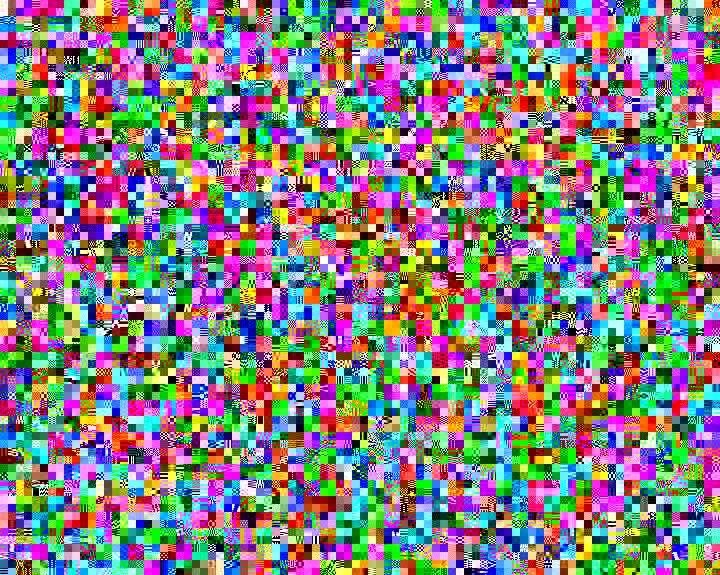
title is a comment about to piranesi's etchings, found in
ficacci, l, [2001]. giovanni battista piranesi: selected etchings, taschen, italy p.12
image is a would-be 'pixelated' noise screen my computer gave me today when i tried to play a video file, which required a codec i didn't have.
Labels: image, piranesi, quote, square
10 January 2012
escape into purity, by wolfgang bauer
i am pursued by a horde of analogies
i want to escape
their sweet utility
on which i have gorged myself
for too long.
i know that the tree is a tree-of-life
that life is a dream
that the soul is as deep as the sea
and death a constant companion
i that the heavens are a tapestry
that the buzzing of bees a song
and that there are two sides to every coin
that woman is a goddess
reality an illusion...
the city a sea of houses
the night a mantle
the sun a ball
the moon a sickle.
out with you,
you cooing metaphors
i want to make poetry:
under the blue sky
in a green meadow
sits a beautiful woman
in her hand is a bunch of daisies
her dress is blue.
in a dark room a man
sits and eats his soup
he quickly empties the bowl
wipes his mouth and
goes down into the cellar.
the pretty woman comes home
the man is already sitting with his wine
she makes him a bite to eat
oh, how fine.
how beautiful and simple is the world
how joyous a life
without metaphors.
■
the art of fiction
...
21 November 2011


This labour past, by Bridewell all descend,
(As morning prayer, and flagellation end)
To where Fleet-ditch with disemboguing streams
Rolls the large tribute of dead dogs to Thames,
The king of dikes! than whom no sluice of mud
With deeper sable blots the silver flood.
'Here strip, my children! here at once leap in,
Here prove who best can dash through thick and thin,
And who the most in love of dirt excel,
Or dark dexterity of groping well.
Who flings most filth, and wide pollutes around
The stream, be his the weekly journals bound;
A pig of lead to him who dives the best;
A peck of coals a-piece shall glad the rest.
image - a drawing of the fleet river by 'mr crosby,' 1844
Labels: london, poetry, quote, satire
14 November 2011
my sister married a year ago, this month.
at the wedding reception i pretended
that my camera was a girlfriend or date.
the evident yearning for social,
and otherwise interpersonal intimacy,
through contrived anthropomorphising,
spins perversion, amusement and analogous-thought
into warm and shocking revolutions
performance artist, and good friend, kate janes explores similar self-aware, self-conscious things in her work.

This work is called ‘Hostess’ and consists of a series of photographs of papier mache heads on sticks which are guests at a fantasy dinner party, where I am the perfect hostess, confident, witty and the centre of attention. This is in somewhat stark contrast to reality and these images depict an afternoon where I called the shots.
Labels: kate janes, narrative, photography
3 November 2011


Labels: archaeology, drawing, history, introduction, london, mythology
29 October 2011
 |
“the seeking of new structures and patterns that may be used by writers in any way they enjoy.” Constraints are used to trigger new ideas and the Oulipo group is an ongoing source of novel techniques, often based on mathematical ideas — such as counting letters and syllables, substitution algorithms, permutations, palindromes, and even chess problems.”
as published on the matzine website
Labels: editorial, matzine, poetry, words
last night stephen mackie & i, armed with needles & thread strung past issues of matzine on a wall at zap architectures after party, in the basement of hoxton Gallery. the party was to celebrate the opening of the pavilion of protest earlier that day, exhibited in riba's prestigious florence hall. a bit of more guerilla-exposure tactics athankyouverymuch.
Labels: guerilla, matzine, photography, stephen mackie
22 October 2011

 |
 |
i have found no evidence that these great minds ever met in person. like some sort of
necro-networking nitwit i’m strangely star-struck by bringing these voices into close proximity. i mean, these dead-guys really seem to be talking, arguing and believably ignoring each other! imagine the bizarre weaves of conversation that other script machines could conjure
the script machine
- interview with jorge louis borges
- interview with josef albers
- 7 comments from each interview, in alternating fashion
- the artist to begin will be judged by a flipping of a 1p coin; heads = borges, tails = albers. [coin flipped 11:50am 5th sept 2011]
- each comment can be one or more sentences long, though the final sentence must end with a question mark [?] for it to be considered usable.
- prime numbers dictate the number of entry used to compile script

Labels: albers, borges, collage, history, illusion, interview, matzine, script, words
22 August 2011


i return to you years later,
grey & lovely city
unchanging city
buried in the waters of the past
i'm not longer the student
of philosohpy, poetry & curiosity,
i'm not the young poet who wrote
too many lines
and wandered in the maze
of narrow streets and illusions
the sovereign of clocks and shadows
has touched my brow with his hand
but still i'm guided by a star
by brightness, and only brightness
can undo or save me
star by adam zagajewski. i read this on a wall in london's underground tube network, on my way home from leeds & birmingham [as part of project context]. i have a fit of goosebumps on every pass. i'd suggest scanning this interview with zagajewski, it takes my mind to far away places and spreads my eyes apart.
i've been blogging less than i use to because my time is spent elsewhere, in those hidden places for where only few keys exist; sketch books, conversations... but these two photographs above are my studies following josef albers' 'interaction of colour'. the top colour study is from chapter 9 entitled 'colour mixture in paper - illusion of transparence' and the bottom photograph is from chapter 14 'colour intervals and transformation'
the virtuous hunt
for ways of seeing
spears bounty abound;
a game no trap ensnares
Labels: albers, colour, drawing, illusion, poetry
5 July 2011
josef, étienne & i
"the search is what everyone would
undertake if he were not stuck in the
everydayness of his own life. to be
aware of the possibility of the search
is to be onto something. not to be
onto something is to be in despair"
walker percy, the moviegoer
[as quoted on page 1 of 'seeing is forgetting the name of the thing one sees' by lawrence weschler]
 the image above is my submission to the copy/paste issue of matzine#09; it is of two beds, one for étienne and one for i - two characters from a short story i wrote for the previous issue. i had built part of a miniature stage-set for the piece but the simplicity of this spread, the strange divide of the spine, the butterfly and clone effect, the floating beds in paperspace and the questionable penmanship - these qualities won me over.
in a 1968 interview, josef albers said something provocative, that has stuck with me and seems pertinent here :
"the source of art - or where it comes from - is the discrepancy between physical fact and psychic effect"
Labels: albers, depth, drawing, dreams, irwin, matzine, quotes, square, vision
3 July 2011

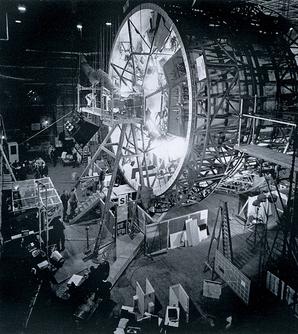
sunday 19th june saw me lending my brick threading skillz to the f o l l y f o r a f l y o v er team
cool, engaged bunch - the get-up had a great ad-hoc vibe and the competence to pull it off
hats off
[looking forward to 2001 : space odyssey]
Labels: architect, assemble, collaboration, collage, image, narrative, set design, urban
4 June 2011


Labels: collaboration, drawing, image, irwin, kubrick, mythology, quote, set design
19 May 2011

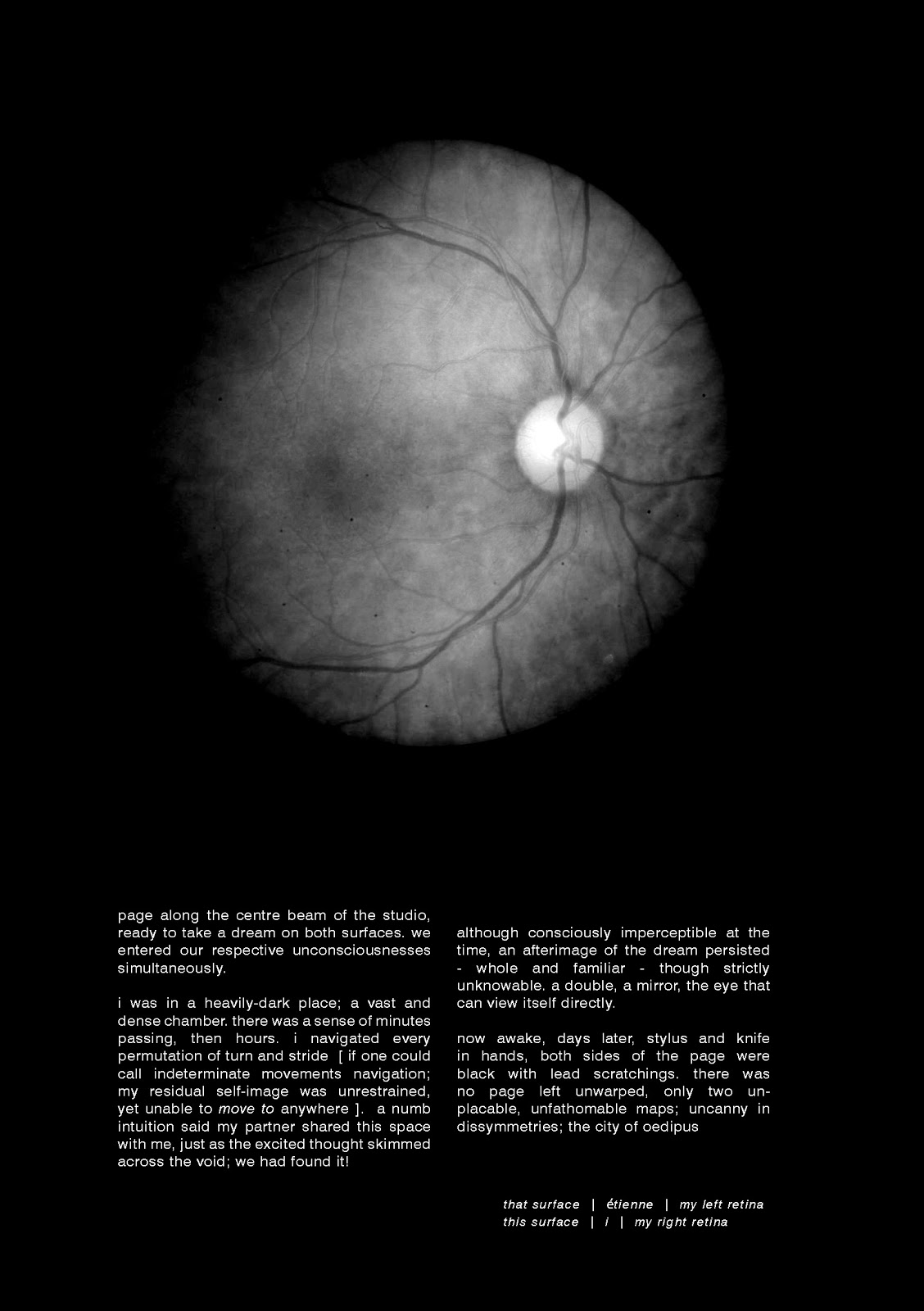
the city of oedipus
[as published in matzine #08]
like clockwork, étienne + i would spend two long days a month in studio monoculeure. always, the first studio day was the first friday of the month; the second, the second saturday
in turns, one would fall asleep, or employ chloroform. meanwhile the other, thirty three minutes later, would shake his friend awake, whereupon the dreamer would take his dream and put them on a page; the dimensions of their studio wall.
friday, my turn, i inhaled fully and closed my eye. a moment passed before i opened again. absurdly, both étienne and the fresh, wall-sized page were nowhere to be seen.
eight days following, in studio monoculeure, étienne and i met again, rather upset with one another. an emphatic, erratic explosion of airborne blame ensued. étienne defended that the previous friday it had been his turn to capture his dream on the page. only, when he opened his eye the room was empty of both partner and page.
disturbed and irreconcilable, we could agree on only one thing; to meet again twenty days later.
friday, the first day of the month, with little trust or patience surviving, we hung the page along the centre beam of the studio, ready to take a dream on both surfaces. we entered our respective unconsciousnesses simultaneously.
i was in a heavily-dark place; a vast and dense chamber. there was a sense of minutes passing, then hours. i navigated every permutation of turn and stride [ if one could call indeterminate movements navigation; my residual self-image was unrestrained, yet unable to move to anywhere ]. a numb intuition said my partner shared this space with me, just as the excited thought skimmed across the void; we had found it!
although consciously imperceptible at the time, an afterimage of the dream persisted - whole and familiar - though strictly unknowable. a double, a mirror, the eye that can view itself directly.
now awake, days later, stylus and knife in hands, both sides of the page were black with lead scratchings. there was no page left unwarped, only two un-placable, unfathomable maps; uncanny in dissymmetries; the city of oedipus
[this is a fictional foray originally presented in matzine #08 in response to the idea 'domestic exotic'. i really enjoyed writing this - and exposing my retina's to the matzine readers was an added delight]
Labels: borges, dreams, light, matzine, mythology, shadow

[image: joiner of tmle presentation in action]
stephen mackie and i were invited to talk at the modern language experiment; a critical art, practice + theory forum. this took place on 17th may. we decided to present our collaborative work, drawing attention to the progression of our processes over the past year, between the black mill project and the meta architecture exhibition.
the group discussion around our subjects was most welcomed, raising some unexpected questions about our work. thanks to matt and keh from t.m.l.e. for arranging the event and alan magee for co-presenting the evening with us
Labels: black mill, critique, london, meta architecture, presentation