10 May 2010
 |  |  |  |


the solaris project is on the cusp of completion, if that can be said before 2186.
the final reviews are imminent.
this is the text with which the images were accompanied;
nothing disappears completely
“darkness is not the mere absence of light; it has some positive quality... darkness is ‘thick’; it directly touches a person” roger caillois, 1935
do we need to see in order to feel darkness?
how much light do people need in order to live, and how much darkness? is it even possible to imagine things without light? can we see something without interacting with it?
what is light? is it an illusion?
visual field = light x space
the drawings presented here make up ’the solaris project;’ the basis of a study into enigmatic qualities of light, of things we can just see. this design is effectively of a large optical instrument, carved from the side of a mountain in columbia, south america. the parameters of the design respond to several associated sources; how humans perceive light; our eyes, our visual perception of the visual field; the physics of light, tarkovsky’s 1972 film solaris and a total solar eclipse.
the entrance responds to scotopia; our eyes adaptation to dim light, the buildings ‘windows’ act as ducts for light, tracing the path of the sun across the sky, beginning 08:57:30 on 16th july 2186. at the heart of the building there is a void, with one seat and one screen, on which the film solaris will be projected.
drawings: etching print and acetone transfer
▪▪▪
5 May 2010
projectors,
phi phenomenon and the
psychophysics of vision

image: the incremental tilt and shift of projected film solaris; orthographic plan view - top middle right
the aspect ratio of the projected image is maintained by the cross-sectional proportion of each light vent, rather than a condenser lens as you would find on a conventional projector. although, in the strictest sense, since the original film reel of solaris is in anamorphic format, with 2.35:1 aspect ratio, the horizontal plane of image is condensed, only later to be expanded by the appropriate, opposite affecting lens; a module attachment for the projector.
the persistence of vision is upheld by the mechanical cylindrical shutter housed on the projector. this removes the otherwise apparent flicker of the moving film image. considering the widely accepted flicker fusion threshold for humans to be roughly 16hz, solaris will have to be projected at a faster rate than this. in fact, the shutter and film will both operate at 24hz.
▪▪▪
29 April 2010
black mill
black mill is a short film, which supports my masters thesis in architecture. it is a film based on the film noir genre; a detective story set in a derelict building on the outskirts of dundee city centre.
in this film i investigate qualities of natural, incidental light and methods of representation with the video medium. with this production i was particularly interested to experiment with ideas of cinematography, such as video collage, time-delayed overlays and 'panning through walls'. the film was a collaborative project with fellow student of architecture, stephen mackie. stephen acts as the detective.
having completed this project, the film is, for me, somewhere between a building survey and an architectural proposition. the existing ruinous qualities of the old mill are catalogued, inseparable from an entirely subjective, [although at points hyper-real] experience of spaces.
this film runs for 15mins it has been split in two parts, as below
both parts, amongst other short films of mine, can be found on my youtube channel
headphones are advised
"of darkness visible so much be lent,
as half to show, half veil the deep intent"
[ alexander pope, 1943, dunciad, book IV, the poems of a. pope]
▪▪▪
28 April 2010
"the divine light penetrates the universe according to its dignity"
[dante, c.1300, the divine comedy]
the following sketch is of 'room 55985;' the chamber where solaris is to be played. drawn with a lithograph crayon, the image is an attempt to represent the curvature of the inner surface of a sphere, with multiple point-perspective field of view. the viewer/camera is somewhere above this one punctual spectator, not quite in the centre of the apparent sphere, looking down onto the top of this column.
within the body of the column are two concentric spiral staircases - rotating against each other. one to reach this privileged position, the other to leave.
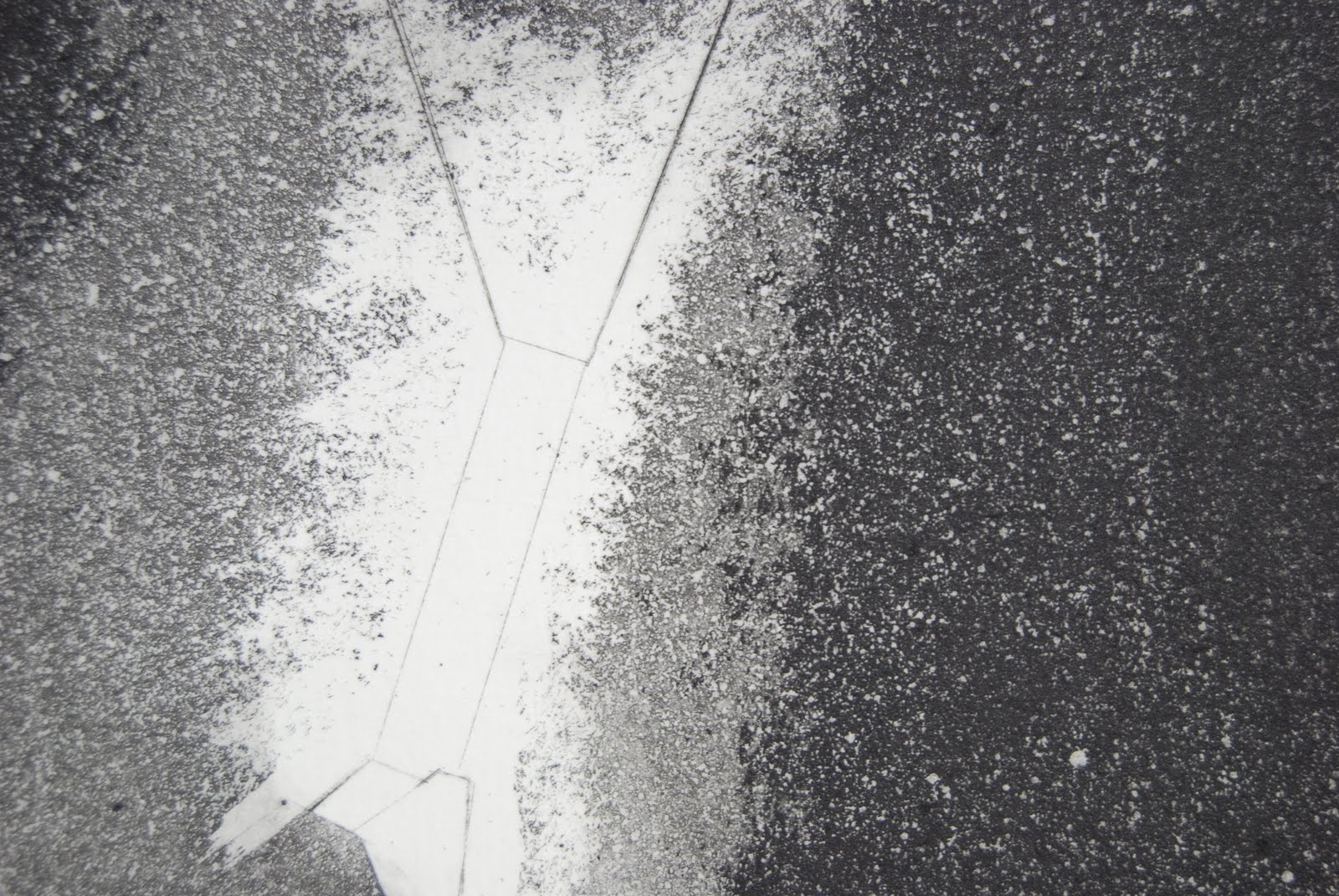
'black 55985' is the name of etching ink used to print this plate. this black is particularly dark, with an imperceivable brown hue.

08:57 16th july 2186
geo. latitude 4° 38' n
geo. longitude 74° 05' w
julian date 206
declination -11.6029
hour angle [at 09:00] 45°
2186 is not a leap year
for further explanation, derivatives and equations see here
▪▪▪
17 April 2010

my design proposal is essentially a giant optical instrument carved into the side of a mountain.
somewhere between astronomical observatory and epic cinema theatre, the form of this design is finely tuned to a rare total solar eclipse.
part of the intention is to explore the periphery of our vision, not just our field of view, but also our range of contrasts, our limits of luminescent perception, pure white and absolute black, our ability to project image, as well as receive. ask the question 'how can this affect space?'
part of the intention is to bring into close relationship the scales at which light affects us; on one hand, the sun illuminates over half our planet with a blinding 90,000 lux from 149,600,000,000 metres, whereas the human eye can adapt to use just 1 lux of light, as from the full moon close to the equator.
image: sketchbook entry for matzine#004. image was experiment in expanding the field of view to include the implausible. you are both behind and in front of a wall.
_
▪▪▪
16 April 2010

-a-
monumental
subterranean
optical
instrument
-for-
showing
tarkovsky's
solaris
-on-
sixteenth
july
twenty
one
eighty
six
-at-
nine
fourty
two
a
m
"light gives of itself freely, filling all available space. it does not seek anything in return; it asks not whether you are friend or foe. it gives of itself and is not thereby diminished"
[michael strassfeld]
"it seemed to be a necessary ritual that he should prepare himself for sleep by meditating under the solemnity of the night sky... a mysterious transaction between the infinity of the soul and the infinity of the universe"
[victor hugo, les misérables, 1982, p67]
image: contour-collage of site and entrance
▪▪▪
15 April 2010
"the obscurity of a "mystery" comes from images that a kind of lucid dream borrows from the realm of the crowd, sometimes bringing to light what the guilty conscience has pushed back into the shadows, sometimes highlighting figures that are routinely ignored"
[georges bataille, 1985, visions of excess: selected writings, 1927-1939, university of minnesota press, p213]


my latest print is the engine room of my design proposition
from here, extremely long and thin vents channel direct sunlight deep into the heart of the mountain, for processing. this light needs to be measured, controlled, timed and otherwise heavily manipulated before it reaches the screen.
concentrated, the intensity of this light would blind you.
▪▪▪
5 April 2010


1, 3 scotopia, 2 trajan's seat
it is time for a point of departure in my work.
a written segment of my thesis is in existence.
existing drawings are being re-evaluated.
fresh drawings are riding that edge of nothingness,
the event horizon.
light is something you can’t touch,
you can’t see it,
move it
or weigh it.
light doesn’t need air.
in the morning,
light visits distant planets
and bounces back to earth,
before you boil your kettle.
and light can travel-time.
if I ask the question ‘what is light?’ my immediate response, as a student of architecture, would be to find an answer here: “architecture is the masterly, correct and magnificent play of masses brought together in light” [le corbusier, 1927] but in fact this answer seems to have dodged the question entirely.
▪▪▪
4 April 2010
matzine #004
the sketchbook edition
[you might find a mirror useful]
[also, mackinnon-pryde does a good job of explaining what a zine is]


_
▪▪▪
30 March 2010
“darkness is not the mere absence of light; it has some positive quality. whereas bright space disappears, giving way to the material concreteness of objects, darkness is “thick”; it directly touches a person, enfolds, penetrates, and even passes through him. thus the “self is permeable to the dark but not to the light”; the feeling of mystery we experience at night probably stems from this.” [Caillois, 1935]
i’m reminded of the otherwise insignificant moments when i walk down the level 6 corridor and the low-penetrating evening sun triumphs in casting odd blades of pure light deep in the heart of the building. if every deviation from the earth’s surface can act as a sun dial, in a sense, the matthew building is a well crafted time-machine.

▪▪▪

above, the vacant observatory on ballgay hill
below, a few prominent historical thinkers. they understood light before anyone else
a note: this a draft post that should have been published a long time ago
alhazen
conceived the notion that light rays do not travel from our eyes, but rather from luminous sources into our eyes. reflective surfaces + the camera obscura
roger bacon
understood the principle of the rainbow
rené descartes
"And so something which I thought I was seeing with my eyes is in fact grasped solely by the faculty of judgment which is in my mind"
descartes used an ox's eye to determine that we infact see an upside down image of the world
cogito ergo sum (English: "I think, therefore I am")
▪▪▪
26 March 2010
in a way, my project has always been on its site.
i simply hadn't found it.
actually, i didn't known what i was looking for.
did friedrich bessel know?
condition one
the instrument is built around the total solar eclipse commencing july 16th 2186, 15:14:54
condition two
the trajectory of this significant eclipse follows a thin path across the surface of the earth. the only landfall occur in south america
condition three
to increase the chances of the instrument using/experiencing the eclipse, cloud and atmospheric interference need to be reduced. therefore high altitude is required.
condition four
the programme of the instrument suggests that a sharp change in surface inclination could aid the exit route. this could take the form of a cliff, mountainside, impact crater wall, crevasse etc...
▪▪▪
24 March 2010

clarifying your resistance
following on from monday's critique of my thesis project, i'm currently embarking to clarify 'that which is offering my project resistance' or a solid position on origin and process of my decision making.
the script
the stage directions
the narrative
the site
the physics of light
the human physiological restrains
the human psychological condition
the natural light
the proprioception of space
the path of the sun
the longest theoretical eclipse
on July 16 2186, a solar eclipse lasting 7 minutes and 29 seconds, it is the longest solar eclipse between the dates of 2000bc and 3000ad]
the realisation of illusion
i doubt that my interest is simply in illusion
there is something special in that moment when an apparent illusion is reduced into reality - when the joy of mystery is confirmed as truth - when miracles happen before our eyes. have you ever questioned the actuality of a cantilevered thing? you say to yourself, 'it must be some sort of trick'. well it is, and that's fine. but something did become real, something impossible happened. how self gratifying it is to have been the thing that experienced the realisation of illusion.

▪▪▪
19 March 2010


i've been playing with the idea of illusion. it is an idea, illusions only exist between [...]. the quoted definition below has a conflict. is illusion a misleading impression, or misapprehension of reality? i'm inclined to favour 'misapprehension' as the more accurate description - an experience accountable only to your self.

i'm not sure 'misleading impression' actually makes sense. surely impressions are highly subjective, likely-irrational-things from the outset. what in gods good name, then, is a misleading impression?

aside from the origin of the word illusion, its 'cheap' connotations and other things besides, i'm coming to warm to this descriptive noun.
–noun
1.
something that deceives by producing a false or misleading impression of reality.
2.
the state or condition of being deceived; misapprehension.
3.
an instance of being deceived.
4.
Psychology. a perception, as of visual stimuli (optical illusion), that represents what is perceived in a way different from the way it is in reality.
5.
a very thin, delicate tulle of silk or nylon having a cobwebbed appearance, for trimmings, veilings, and the like.
6.
Obsolete. the act of deceiving; deception; delusion.

a note on the images appearing in this post.
it took the shape of a 1w*1d*2h metre 'hung' space, with blackout curtains draped, wrapped and slung around a suspended, square-section, aluminium frame.
i relied on clamps, pins and lab-style, miniature scaffolding.
expect more evidence to follow
▪▪▪
18 March 2010

what does context mean?
since matriculating
190 days
16416000 seconds
4026 words for thesis
4.9248x10^15 metres distance travelled by morning light reflected off my drawing board in studio
3x10^8 metres per second is the speed of light
16.6x10^12 metres from our sun of the furthest man made object, Voyager 1
15 hours 27 minutes is how long the light reflected off my drawing board took to overtake the furthest man made object from the sun
▪▪▪